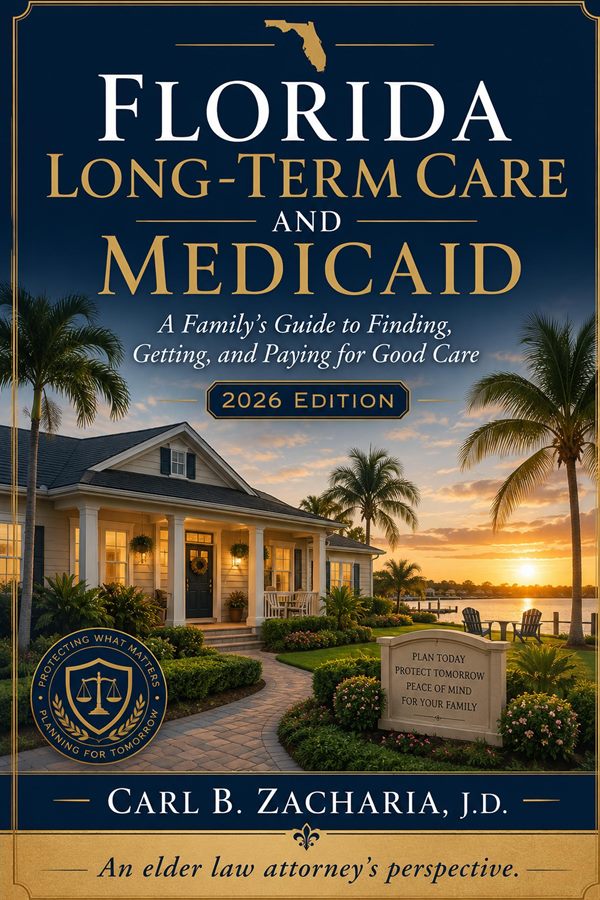
Florida Long-Term Care and Medicaid is a plain-English guide for Florida families who need to pay for long-term care without losing everything they have built. It explains what Medicare covers and where it stops, how Florida's Medicaid income cap and asset limits work, what the five-year lookback penalizes, and how the family home is protected — and lost. Written by an elder law attorney who has guided Florida families through these decisions for three decades.
The book explains the long-term-care system in plain English: choosing the right care setting, who pays and when Medicare does not, Florida Medicaid's income and asset rules, homestead protections, powers of attorney, spend-down planning, and Qualified Income Trusts. Written for families, not for lawyers.
These are national median costs from the most recent CareScout (Genworth) Cost of Care Survey. Florida costs generally run above the national medians. At these rates, a lifetime of savings can be consumed in two to three years of care — which is the arithmetic that makes the timing of planning matter so much.
National median cost of long-term care by setting, 2025
The most expensive misunderstanding families arrive with is the belief that Medicare will cover a nursing home stay. It will not, beyond a short and conditional window.
What each payer covers and does not cover for long-term care in Florida
Payer
What it covers
Where it stops
Medicare
Short-term skilled nursing after a qualifying inpatient hospital stay — up to 100 days per benefit period, with full coverage only for the first 20.
Long-term custodial care: help with bathing, dressing, eating, and supervision. This is the care most nursing home residents actually need.
Private pay / savings
Any setting, immediately, with no eligibility rules and no waiting.
Last, at these prices. This is the phase where families spend down assets that planning could often have protected.
Long-term care insurance
Benefits per the policy — typically a daily or monthly amount for a defined benefit period.
Help if it was never purchased, and it generally cannot be bought once care is already needed.
Florida Medicaid (ICP)
Ongoing long-term custodial nursing home care for applicants who meet the medical and financial tests.
Pay before eligibility is established — and a transfer penalty can delay that for months or years.
These are the numbers that decide eligibility for Florida's Institutional Care Program — the long-term care Medicaid that pays for nursing home care. They move on two different schedules: most reset each January with the Social Security cost-of-living adjustment, while the minimum MMMNA, the Shelter Standard, and the monthly penalty divisor reset each July 1. Each figure below is labeled with the cycle it follows.
Monthly income cap (single applicant, ICP)
$2,982
Gross monthly income, equal to 300% of the SSI federal benefit rate. Income above this does not disqualify an applicant outright — it is what a Qualified Income Trust exists to solve.
Resets each January
Countable asset limit (single applicant)
$2,000
Applies to countable assets only. The homestead, one vehicle, and certain other property are treated as exempt and are not counted toward this figure.
Resets each January
Community Spouse Resource Allowance (maximum)
$162,660
The most the at-home spouse may retain in countable assets. Florida applies this as a flat maximum, not as half of the couple's combined assets — a point most national summaries get wrong for Florida.
The income floor guaranteed to the at-home spouse, set at 150% of the federal poverty level for a two-person household. Where their own income falls short, income from the spouse in care can be diverted to make up the difference.
Resets July 1
Excess Shelter Standard
$811.50 per monthEffective July 1, 2026
Exactly 30% of the minimum MMMNA. Shelter costs above this standard let the community spouse's income allowance rise above the floor, so a couple with high housing costs may keep more income than the minimum suggests.
Resets July 1
Monthly penalty divisor
$10,645Effective July 1, 2026
Florida's average monthly private-pay nursing home cost. A disqualifying transfer is divided by this figure to produce the number of months Medicaid will not pay - so a $100,000 gift creates roughly 9.4 months of ineligibility.
Resets July 1
Personal Needs Allowance
$160 per month
What a Florida nursing home resident on Medicaid keeps from their own income. The remainder, after allowable deductions, is paid to the facility as patient responsibility.
Figures verified August 27, 2026. Eligibility turns on facts that vary by household; confirm current figures before relying on them.
What You Will Learn
Written for families, not for lawyers. No prior knowledge of Medicaid is assumed.
Compare home care, assisted living, memory care, and nursing homes
Understand who pays for care — and when Medicare does not
Navigate Florida Medicaid eligibility, income limits, and asset rules
Protect the family home and avoid common gifting mistakes
Use the right legal and planning tools before a crisis strikes
Topics Covered
Inside the Book
The rules that decide whether a Florida family keeps what they have built — explained one at a time.
Florida Long-Term Care and Medicaid: Common Questions
The questions families ask first — and what the book covers in depth.
Does Medicare pay for nursing home care in Florida?
Generally, no — not for long. Medicare covers up to 100 days of skilled nursing care per benefit period following a qualifying inpatient hospital stay, and only the first 20 of those days are covered in full; days 21 through 100 carry a daily coinsurance. Coverage also continues only while the resident needs daily skilled care, so it frequently ends well before day 100. What Medicare does not cover at all is long-term custodial care — help with bathing, dressing, eating, and supervision — which is the care most nursing home residents actually need. When Medicare stops, families pay privately or turn to Florida Medicaid.
The national median for a semi-private nursing home room reached $315 per day — $114,975 a year — in the 2025 CareScout Cost of Care Survey, with a private room at $355 per day, or $129,575 a year. Assisted living ran a national median of $6,200 a month, and an in-home non-medical caregiver $35 an hour, which comes to roughly $80,080 a year at 44 hours a week. Florida costs generally run above the national medians. At those numbers, an average retirement's worth of savings can be consumed in two to three years of care, which is why the timing of planning matters so much.
What are the income and asset limits for Florida long-term care Medicaid in 2026?
For 2026, a single applicant for Florida's Institutional Care Program must have gross monthly income at or below $2,982 and no more than $2,000 in countable assets. Florida is an income-cap state, which means income even one dollar over the cap makes an applicant ineligible outright — spending it down on care does not fix that by itself, and the solution is a Qualified Income Trust. On the asset side, the $2,000 figure applies only to countable assets: the homestead, one vehicle, and certain other property are exempt and are not counted. Both figures reset each January with the Social Security cost-of-living adjustment.
What is a Qualified Income Trust, and do I need one?
A Qualified Income Trust — also called a QIT or Miller Trust — is the legal tool that solves Florida's income cap, and it is authorized by federal law at 42 U.S.C. § 1396p(d)(4)(B). Income above the cap is deposited into the trust each month and disbursed under rules Medicaid accepts, which allows an applicant whose income exceeds $2,982 a month to qualify. Two things routinely go wrong with it: it must be drafted correctly, and it must be funded every single month without exception. A QIT that exists on paper but was not funded in a given month does not work for that month. If the person needing care has gross monthly income above the cap and needs nursing home Medicaid in Florida, a QIT is not optional.
Not as a condition of eligibility — the Florida homestead is generally an exempt asset, so owning a home does not by itself disqualify an applicant, and Florida's constitutional homestead protection at Art. X, § 4 is among the strongest in the country. The real exposure comes afterward, through Medicaid estate recovery under Fla. Stat. § 409.9101, and from well-meant moves made in between. Deeding the home to a child is the classic example: it can trigger a transfer penalty, forfeit the homestead protection, and hand the child a capital gains problem, all at once. Florida gives families more room here than most states, but only if the protections are used deliberately.
When someone applies for long-term care Medicaid, the state reviews the previous 60 months of financial records for assets given away or sold for less than fair market value — the lookback is set by federal law at 42 U.S.C. § 1396p(c). Transfers found in that window create a penalty period during which Medicaid will not pay for care, calculated by dividing the total transferred by the monthly penalty divisor - Florida's average monthly private-pay nursing home cost, which is $10,645 as of July 1, 2026 and resets each July. A $100,000 gift therefore buys roughly 9.4 months during which Medicaid pays nothing; $50,000 buys about 4.7. The critical detail families miss is timing: the penalty does not run from the date of the gift. It begins when the applicant is otherwise eligible and already needs care — the exact moment the family can least afford to pay privately. Ordinary generosity counts: a wedding gift to a grandchild, informally paying a daughter to provide care, or signing a car over to a relative.
What happens to the healthy spouse when one spouse needs a nursing home?
Federal spousal impoverishment rules at 42 U.S.C. § 1396r-5 exist specifically to keep the at-home spouse — the community spouse — from being left destitute. In 2026 the community spouse may retain up to $162,660 in countable assets under the Community Spouse Resource Allowance, and may also be entitled to divert income from the spouse in care through the Minimum Monthly Maintenance Needs Allowance, whose floor rose to $2,705 a month effective July 1, 2026 - set at 150% of the federal poverty level for a two-person household. Where the couple's shelter costs exceed the Excess Shelter Standard of $811.50 a month, that allowance can rise above the floor. One Florida-specific point matters a great deal here: Florida applies the resource allowance as a flat maximum, not as half of the couple's combined assets subject to a floor and cap. Most national summaries describe the halving formula, which means general internet guidance is frequently wrong for Florida in a way that costs the community spouse money.
When should a Florida family start long-term care planning?
Before a crisis, whenever that is possible — the 60-month lookback means the most protective options need time to season. But planning after a diagnosis, after a fall, or after a loved one has already been admitted is far from hopeless. Crisis planning is a real and established practice, and meaningful assets can often still be protected for a spouse or a disabled child even when someone is already in a facility. What is genuinely irreversible is money already spent and transfers already made without advice. The most common and most expensive outcome in this field is a family spending down to nothing because no one told them there were lawful options.
Who should read this book?
Families facing a long-term care decision in Florida: adult children helping a parent, spouses planning together, and anyone who would rather understand the system before being forced to navigate it under pressure. It is written in plain English and assumes no prior knowledge of Medicaid. It is educational, and it is not a substitute for legal advice about a specific situation — eligibility turns on facts, and the facts vary.
Last reviewed: . Florida's income cap, countable asset limit, Community Spouse Resource Allowance, and Personal Needs Allowance change every January with the Social Security cost-of-living adjustment. The minimum Monthly Maintenance Needs Allowance, the Shelter Standard, and the monthly penalty divisor change every July 1.
This page and the book it describes are educational. They do not create an attorney-client relationship and are not a substitute for legal advice about your own situation.
Want to Know Where Your Own Family Stands?
The book explains the system. The Family Protection Review shows you how your own plan holds up against it — free, in about a minute, with no contact information required.